少年派的奇幻漂流
Vessel tests begin along China's major river-to-sea Pinglu Canal_我的网站

A |
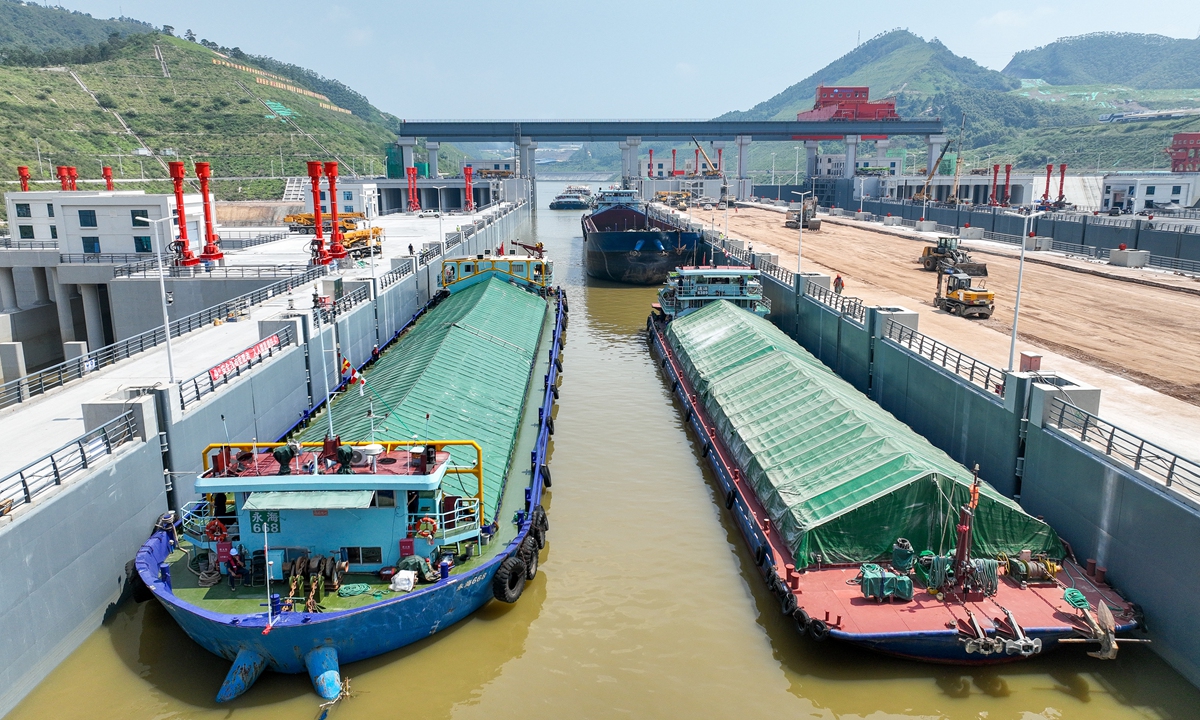
Vessels enter a ship lock of the Pinglu Canal in Lingshan county, Qinzhou, South China's Guangxi Zhuang Autonomous Region on August 12, 2026.
Equipped with China's homegrown BeiDou positioning systems, drones and sensors, four vessels began trial runs along China's Pinglu Canal on Wednesday. The canal, which is planned for opening in September, will greatly inject economic vitality to areas along its route and turbocharge China's trade connection with the ASEAN with its cost-saving transportation, a Chinese analyst said.
The vessels conducting trials on Wednesday represent the main types expected to sail on this canal, namely loaded and unloaded 5,000-tonne ships as well as loaded 3,000-tonne and 1,000-tonne vessels, Xinhua News Agency reported.
The trials began when an unloaded 5,000-ton vessel departed from the Xinfu service area along the canal in South China's Guangxi Zhuang Autonomous Region, the Xinhua News Agency reported.
With sensors collect data on their routes, movements, water currents and safe distances between ships, the tests will assess navigation under both normal and adverse conditions and examine whether the canal's waterways, locks, anchorages, service areas and navigation facilities are ready for operation.
Chinese analysts said the tests starting on Wednesday, days after the canal completed its first full-route patrol, indicated that the canal is one step closer to its scheduled opening in September as final preparation work ramp up.
Zheng Ping, chief analyst at industry news portal chineseport.cn, told the Global Times on Wednesday that as a major project in the nation's water network, the opening of the canal later this year will bring sea changes to areas along its route with fresh economic opportunities with its role as a low-cost enabler for domestic and international trade.
"Inland water traffic has great advantage in transportation capacity and costs. While a train can typically carry 20 40-foot container or more, a waterborne vessel can easily carry over 100 such containers. So a five-times capacity is gained here, greatly reducing transportation costs for goods," Zheng said.
For goods that are not time sensitive, or for bulk cargo such as coal, aluminum or fertilizers, waterborne traffic has unparallel advantage, the expert noted.
The 134.2-kilometer-long Pinglu Canal is a key project of the New International Land-Sea Trade Corridor. With total investment exceeding 70 billion yuan ($10.37 billion), the canal begins at the Pingtang River estuary in Hengzhou, administered by Nanning, follows the Qinjiang River into the Beibu Gulf, according to Xinhua News Agency.
It is China's first major river-to-sea canal project planned and coordinated at the national level since 1949 and is designed to accommodate vessels of up to 5,000 tons.
In addition to facilitating transportation, modern canal system will also have the function of water resource diversion, flood control and irrigation, greatly boosting up local economic development, Zheng said.
Lei Xiaohua, deputy director of the Institute of Southeast Asian Studies at the Guangxi Academy of Social Sciences in South China's Guangxi Zhuang Autonomous Region, told the Global Times on Wednesday that the Pinglu Canal will serve as a new engine for the deep integration of industrial chains between China and ASEAN.
"Raw materials from ASEAN can enter China's hinterland via the Beibu Gulf ports at lower costs, while Chinese exports including aluminum products and building materials can reach Southeast Asia more efficiently," Lei said.
Against the backdrop of deep industrial chain integration between China and Vietnam, the canal, which offers a low-cost, high-capacity transport route, is poised to foster new models of cross-border industrial capacity cooperation, said Lei.
When operational in September, the canal will give inland regions in Southwest China a more direct river route to the sea. Cargo that previously had to travel eastward through the Port of Guangzhou will be able to head south directly toward ports in the Beibu Gulf, shortening some inland waterway journeys by about 560 kilometers, according to Xinhua.
The New International Land-Sea Trade Corridor is an international trade and logistics network connecting China's western regions to ASEAN countries and other overseas markets.
The corridor has continued to record strong trade growth. During the first half of 2026, imports and exports transported through the corridor by its participating regions reached 517.23 billion yuan, up 13 percent year-on-year and setting a new record for the same period, per data released by Chongqing municipal government.
The corridor's rail service handled a record 1.425 million 20-foot equivalent units of cargo in 2025, up 47.6 percent year-on-year. As of early June of 2026, its network reached 593 ports in 128 countries and regions.
。 在2023年的福布斯排行榜上,新加坡的富豪榜上,华人占据了显著的位置,今天就让我们把目光聚焦在富豪榜中以97亿美元财富位列第六的张勇和舒萍夫妇。这对夫妇的名字可能不太为人所知,但他们的公司——海底捞,却是家喻户晓。海底捞以其顾客至上的服务理念、标准化的菜品和持续创新的精神,成为火锅餐饮行业的一个标杆。

B | 海底捞发家史总览 1994年,张勇在四川简阳开设了第一家海底捞。当时的他可能不会想到,20年后,海底捞会达到如此的高度。2001年4月,张勇成立了四川省简阳市海底捞餐饮有限责任公司,这是他追逐梦想的第一步。

C | 2004年,海底捞在北京开设了第一家门店,这标志着它从区域品牌转变为全球知名品牌的重要一步。2010年2月,海底捞获得了大众点评网评选的“最受欢迎10佳火锅店”。

D | 2012年,海底捞的海外第一家分店在新加坡克拉码头开业,这是品牌国际化发展的第一步。

E | 2019年8月29日,《福布斯亚洲》杂志发布了最新的新加坡50大富豪榜,张勇以138亿美元的身家登顶榜首。

F | 同年,海底捞在港交所上市,其股价表现出色,张勇夫妇的财富因此大幅增长。火锅大王立足新加坡 海底捞的成功在于其“服务至上、顾客至上”的理念,以及通过建立完善的培训管理体系提供优质服务。截至2023年12月31日,中国大陆地区共有1351家海底捞餐厅,总收入达到了人民币四百亿元,海底捞的策略在于公司涉足火锅全产业链,严格控制食材的品质和价格风险。张勇夫妇的成功背后是无数的努力,如今,他们的身家已经达到97亿美元,但他们已经退居二线,将海底捞交由职业经理人管理。张勇选择新加坡作为归属,是因为新加坡拥有全球最低的税率、优质的教育资源,以及作为全球四大金融中心之一的特殊地位,这些优势也吸引了众多个人和企业来到新加坡。海底捞的成功,不仅仅是张勇夫妇个人的成功,更是整个团队的智慧和努力的结晶。他们的故事告诉我们,只要有梦想,有坚持,有创新,就一定能够实现自己的目标,创造出属于自己的辉煌。
Current article:http://b2t.ganweilingmukuai.shop/news/20260826_9191.html
Published on:20:52:13


 发表于 09:43:35
 QQ好友和群
 QQ空间
QQ空间 腾讯微博
腾讯微博 腾讯朋友
腾讯朋友 收藏
收藏 支持
支持 反对
反对
 发表于 03:12:39


